
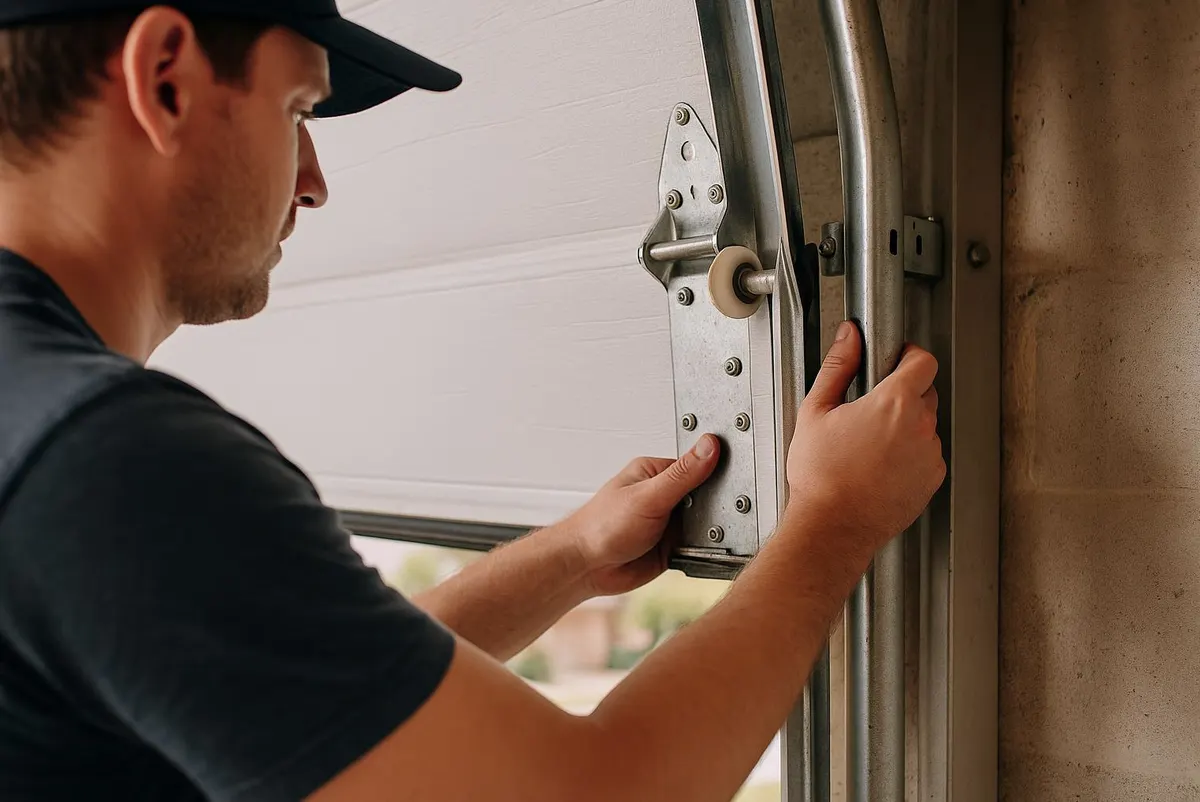
Here's what another season of "it's fine, it's always been fine" actually costs: a snapped extension spring with no safety cable can send a few pounds of steel across the garage at speed. An opener with no auto-reverse can keep closing on a bumper, a bike, or a kid's foot instead of stopping. A bottom panel that's been soaking up winter rain for thirty years can rust through right before the next storm, not during it. None of that is scare talk — it's just what old hardware does when nobody's looked at it in a decade. So before this turns into another round of "we'll deal with it later," here's the actual list of what needs attention and what doesn't.
What a 1990s Door Is Actually Missing
Doors and openers from that era were built before two things became standard: safety cables on extension springs, and photo-eye sensors with auto-reverse on openers. If your door has exposed springs stretched along the horizontal tracks with no cable running through the center of the coil, that's an extension-spring setup without containment — the main failure point. If your opener closes the door all the way even when something's in the way, or if you don't see two small sensor eyes a few inches off the floor on either side of the track, it predates modern auto-reverse logic. Neither of these is a maybe. Both get fixed.
The Real Safety Gaps Worth Fixing Before Winter Rain Sets In
Springs and Safety Cables
If the springs are original, they've already outlived their realistic service life — torsion and extension springs are rated in cycles, not years, and a door opened twice a day for thirty years has used up that rating many times over. The fix isn't always a full spring replacement; sometimes it's adding a safety cable to an extension spring system that's otherwise sound. But if the springs themselves are rusted, stretched unevenly, or you can see gaps between coils, replace them. National ranges for spring replacement typically run somewhere in the $150–$350 area depending on the spring type and whether both need to go at once — and they almost always should go together, since one breaking means the other is close behind.
Opener Sensors and Auto-Reverse
This is the one to stop arguing about. An opener without photo-eye sensors is not a convenience gap, it's a liability — especially in a household with kids, pets, or anyone backing a car out without a clear line of sight. Retrofitting sensors onto an old opener is sometimes possible, but in most cases the opener itself is old enough that replacing the whole unit makes more sense than patching it. Modern openers in the $200–$500 range (installed) typically include auto-reverse, sensors, and a battery backup — useful here given winter rain can trip breakers.
Reinforcement for Shake and Wind
Garages built before seismic retrofit standards became common often have doors with no horizontal reinforcement strut across the top panel, and no bracing tying the door frame to the house structure. This matters more here than in a lot of places — older Orange County garages weren't always built with that bracing in mind. A strut kit and proper anchoring are inexpensive relative to the risk and worth doing once, not something to keep deferring.
Weatherstripping Before the Rain Starts
Original bottom seals on a decades-old door are almost certainly cracked, flattened, or missing chunks by now. That's not cosmetic — it's the difference between water running under the door during winter rain and water staying outside where it belongs. It's also what's been letting dust and, during fire season, wildfire smoke work its way into the garage all summer. New seals are cheap and take an hour. There's no reason to argue about this one.
What You Can Leave Alone
- Original wood doors in good shape. If a wood door has been maintained, sealed, and isn't warping or rotting at the bottom, it doesn't need to be replaced just because it's old — repaint or reseal it instead.
- Decorative hardware and handles. Purely cosmetic hinges, handles, and window inserts don't affect safety and can stay unless you're changing the look on purpose.
- The track, if it's straight and aligned. Old tracks that aren't bent, rusted through, or pulling away from the wall don't need replacing just because the door around them is old.
- A manual lock, if it's not your primary security. If the opener and deadbolt-style lock on the door itself still function, there's no safety reason to rip it out.
When to Call Garden Grove Garage Door
If you're not sure whether what you're looking at is a spring with a safety cable or without one, or whether your opener actually has working auto-reverse, that's exactly the kind of thing to have checked rather than guessed at. Garden Grove Garage Door can do a full inspection, handle Spring Replacement with proper safety cables either way, and take care of Opener Repair & Installation if your unit needs modern sensors and backup power before the rainy season arrives. We'll tell you plainly what's a real risk and what's fine to leave as-is — no upsell on parts that still have life left in them.
If your garage door is older than your car, give Garden Grove Garage Door a call and get it looked at before the next storm rolls through Garden Grove, CA.